Berney has a hauntingly human and almost casual style, centered around a premise that hooks you from the beginning.
Source: Lou Berney’s Award-Winning Novel
Berney has a hauntingly human and almost casual style, centered around a premise that hooks you from the beginning.
Source: Lou Berney’s Award-Winning Novel
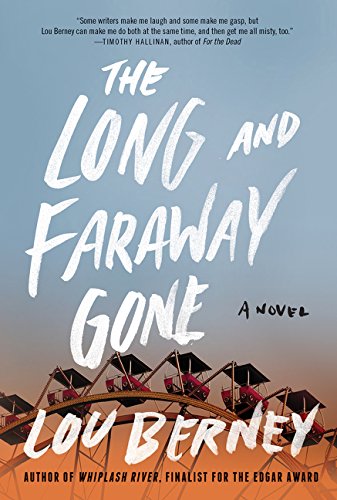
I had already purchased and begun reading Lou Berney’s The Long And Faraway Gone when I left for Bouchercon: Death on the Bayou in New Orleans. So I was not surprised when it won the Anthony Award for Best Original Paperback mystery novel for 2016.
Berney has a hauntingly human and almost casual style, centered around a premise that hooks you from the beginning. What happens to the teenage survivor of a tragedy? The book intertwines two barely related tragedies from the 1980s in the characters of the lone survivor of a robbery turned massacre and the younger sister of a missing teen who vanished.
Wyatt wonders why the robbers killed all his co-workers at the movie theater, but left him alive? Julianna is left forever waiting ‘at the fair’ for her sister Genevieve to come back from an errand that was supposed to take ten minutes. In both cases, there have been no answers for over twenty-five years.
How do you move forward? How do you build a life? Can you ever be close to anyone again, when your closest friends were brutally murdered? How do you stop putting your own life on hold while you pursue every whisper of a lead that will bring you answers? What happens when there will never be any closure?
Berney is equally adept at interweaving the past and the present and multiple viewpoints that leave you aching over the near-miss, the misunderstood, the unknowable. All these characters are damaged, a few are despicable, but all are engrossing. I was haunted by this book for the last several weeks, because like the characters we are left with no neat answers.
For me the message was not in the huge violent tragedy, but the everyday tragedies of people left behind, who can never quite get it together or accept that they can never find the real truth. Because we can never really know what is in someone else’s heart. The miracle is finding the courage to choose love and a purposeful life in spite of that.
The Long and Faraway Gone is published by William Morrow, an imprint of Harper Collins.
•Am I taking full advantage of matching funds? •If not, does my employer do a True Up calculation at the end of the plan year? •Is the plan year based on the calendar year? •What percentage of my p…
Source: Housekeeping Your 401(k)

I usually rebalance my 401(k) investments once a year. This year, doing research for documentation in the financial industry, I picked up a few things you may want to add to your regular financial housecleaning.
The Department of Labor has enacted new guidelines that may wreak havoc in the investment industry in 2017. As we approach year end, it may be worth having a conversation with your broker or benefits coordinator.
All retirement funds have fees attached to them, and I do mean ALL. Some are more obvious than others. For instance, the conversation you have with your broker may be a line item charge. But it will be worth it if you come away understanding the following.
Which of the three types of fees are you paying?
Which of the three common fee calculation methods does your plan use?
The pro rata and hybrid methods calculate fees based on basis points (bps), which are a hundredth of a percentage point of the overall investment, i.e., 0.01%. This translates as 100 bps = 1%. Ask your broker to interpret the fees for you.
Ideally, your Plan Sponsor [if you have a 401(k) or other retirement plan] and the recordkeeping company (Fidelity, Merrill Lynch, TIAA, etc.) try to manage fees. The Plan Services Expense is paid out of what they internally call the Plan Revenue. This has less to do with any profits your investments are recouping and more to do with what they have identified as the price of the plan. The plan aspires to be in balance or revenue neutral. The price designated meets but does not greatly exceed the actual cost of administering the plan. This rarely happens as projections are based on known factors, which do not include other people moving out of the fund or the market soaring or taking a hit. So what you need to ask your broker or benefits coordinator is this:
If you are participating in an employer-sponsored retirement plan with employer matching up to a certain percentage of your compensation, you may be leaving money on the table. Ask the following:
For example, if your employer matches your deduction up to 5% of your annual compensation and you only deduct 3% per pay check, you are cheating yourself. The 2% you have given back to your company on your annual income of $100,000 is $2,000. If you are ten months into the plan year, you have already missed $1,666.67 of matching funds.
But, if your company does a True Up calculation at the end of the plan year, it looks at the total you put in and the total match. If your employer is not meeting the full 5% match, an additional payment is made into your retirement fund. That means, if you up your participation to 10% for the last two months of the plan year, you can make up half of what you gave away.
It breaks out this way, for the first ten months you contributed roughly $250 per month, which was matched 1 to 1. Your plan saw $500 added each month, so at the end of ten months you added $5,000 total. At year end you can expect a total contribution of $6,000. Whereas, if you had put the full 5% in and it was matched 1 to 1 your total contribution would be $10,000 (5% + 5%) for the year.
Changing your deduction to 10% for the last two months will add $1,666.67, but it will only be matched (initially) up to 5% each month, or $833.33. So you add a total of ~$2,500. However, IF your plan does a True Up, it looks at the total amount you contributed: $4,166.67. Less than the full 5%, it should be matched 1 to 1. The total matching contribution at the end of the year is only $3,333.33. Therefore, the company will pay an additional $833.33 in True Up matching funds. Your total contributions to the plan are now $8,333.33. This is still $1, 666.67 less than you might have had at the end of the year, but you can now go back down to 5% for the coming year and come out ahead.
Better yet, leave it at 10% for the first six months of the new plan year to front load your contribution, then lower it considerably during those months you are more likely to need the cash for vacation, school clothes, and holiday gifts. Again, this only works if your employer does a True Up at the end of the plan year, so ask the questions.

In one of my three critique groups, we came up against a common issue in all our writing—using cultural references that don’t work for everyone in your audience. By cultural references, I mean quotes or plot devices from movies, books, TV shows; popular actors or fictional characters; and popular slang.
A number of writing books suggest that using cultural references can be shorthand for communicating a lot about the character, situation, or place. The caution being that it not be too recent or too faddish. If you use the latest slang for your Middle Grade novel or the latest teen heartthrob in your YA novel, it will be dated by the time you get it to your agent, much less published.
A broad spectrum of people may recognize a reference to Jennifer Aniston in Friends, but a much narrower group will understand a reference to Luke Perry in 90210. My PBS-watching friends all quote Downton Abbey, but only a few would recognize quotes from the equally iconic Upstairs, Downstairs.
Sticking to the classics seems to trump the popular. A quote from Jane Austen or Hemingway is probably going to appeal to a wider audience than a quote from Harlan Coben or Janet Evanovich, no matter how many bestsellers they write. The same goes for classic movies, but be careful about assumed knowledge. One of our group is writing a book heavily steeped in Hollywood history and legend, with both real and fictional characters. We occasionally have to remind him that a quote without attribution either in dialog or POV commentary sails right over our heads and makes us feel ignorant. Not what you want your reader to experience.
I thought I was bulletproof when I likened the office of my heroine’s divorce attorney to Sam Spade’s office in The Maltese Falcon. One of the group, who is British-born of Indian descent innocently asked, “Is Maltese Falcon a song?” It served as a reminder that American popular culture is not globally recognized.
I was mystified when her main character acted on her desire to escape an abusive marriage and a life-threatening situation by going shopping with her husband’s credit cards. I didn’t see how it moved the action forward or solved her problem. She patiently explained that upper class women in Indian society were generally submissive and meek and this was seriously acting out. I immediately flashed to the hotelier mother in The Best Exotic Marigold Hotel. I don’t know if either extreme is commonly true of Indian women these days, but I recognize that I am culturally illiterate when it comes to this part of our society and readership.
Have you had to access a college transcript or expired license lately?

The digital age has everyone putting more and more of their lives on their computer, in the cloud, or on an e-reader. I love the simplicity of email and digital submissions to agents. I get my tax refund electronically, and do most of my banking that way. Digital books have completely changed the publishing industry. But, it is very hard for me to make the total digital plunge. I like my digital devices, but give me the plump woody page and inky smell of a pristine new book any day.
I’ve kept paper files for too long. As a young actress doing temp work, a sage executive secretary (they still called them that then) taught me to make triplicate copies of everything and file them under different categories so I could always lay my hands on the information. She was way ahead of meta tagging.
The cloud scares me. It feels like smoke signals. A computer backup company I once subscribed to sent me a notice to pay them a ransom or allow them to destroy my files, without letting me see if they were important!
Back to transcripts. Some teaching applications require electronic copies of transcripts from every college you attended—just to get an interview. If they hire you, you pay to have certified copies sent directly from the university to the hiring school. Unfortunately, none of my three alma maters provide electronic copies. While each is different, the process seems to be:
Sometimes trying to save a little paper ends up costing a whole bunch of money.

If I have a deer in the headlights expression it’s because I’ve been reminded of something important.
You know how it helps to pick up after yourself as you go along, so cleaning day doesn’t become so overwhelming. I thought maintaining my resume as a technical writer was a necessary evil. But I haven’t updated my teaching curriculum vitae in awhile. What a pain!
Some of you may know that I taught at Lone Star College on two campuses for over fifteen years. I let my adjunct classes go when my mother was diagnosed with bone cancer. It was just one too many things to concentrate on and I felt I wasn’t giving my students my full attention. I’ve talked to Ron Jones replacement at CyFair campus (who seems very nice) about starting to teach a class again. Unfortunately, after two years my records in their system have ‘gone away’. So I have to do the whole application process again.
I love teaching, but I’d forgotten what an arduous process this can be. Still it’s a good idea to periodically go in and update my records of past jobs and theater work in one comprehensive place. So I’ll try to think of this as a periodic ‘cleaning house’, and resolve to regularly maintain the darn thing.
I think it was Eleanor Roosevelt who said you should “do one thing that scares you every day.”
Onward and upward!
As you know, when not writing you need to be reading. I try to read the spectrum of mystery fiction. But I have my favorites. This weekend I got to read the much anticipated twelfth book in Louise …
As you know, when not writing you need to be reading. I try to read the spectrum of mystery fiction. But I have my favorites. This weekend I got to read the much anticipated twelfth book in Louise Penney’s series about former Chief Inspector Gamache. It did not disappoint.
On back-order for several months, it arrived as I left for Bouchercon, where I picked up three bags of books to read. But this one stayed at the top of my pile.
Fans will know that Armand Gamache is the former Chief Inspector of the Homicide division for the Sûreté du Québec. Having almost died cleaning up the corruption in the famed police force, he has retired to the sleepy village of Three Pines, which figures greatly in most of the books. Seemingly recovered but bearing the scars, both mental and physical, he passes up grandiose positions to become the new Commander of the Sûreté Academy. It is the last bastion of the evil and decay that almost overwhelmed the division. In what seems an act of insanity, he brings two of his fiercest enemies onto the faculty. The struggle for hearts and minds inevitably leads to a murder and the investigation that targets him as a suspect gradually peels away layers of scandal that shock even Gamache.
Penney skillfully intertwines the central story with a historical thread, following a mysterious map through twists and turns worthy of Dan Brown. But, as always, it is the finely, almost poetically-drawn characters and the rich heritage of Québec that holds us riveted, not the tightly structured plot.
If you are a novice to this fabulous Canadian author, sprint to your nearest used bookstore to find the first book of the series, Still Life. It is not always available at your local box store. Begin at the beginning and follow the twists and turns of the progressive relationships between the varied and wonderful cast of her books. No one stands still; they all grow and evolve, and make terribly human mistakes. My only small disappointment in this book was that Clara, the resident artist of Three Pines played so small a role.
Fans of Louise Penney will know that the release of the last two books were somewhat delayed by the onset and increasingly devastating dementia of her husband, Michael. That she can still write such beautiful prose while coping with this is extraordinary. It is especially poignant since many of Gamache’s most endearing qualities are those she based on her beloved husband.



![IMG_2869[1]](https://chartp.com/wp-content/uploads/2012/11/img_28691.jpg?w=309&h=206)

Claire Hart-Palumbo in The Year of Magical Thinking

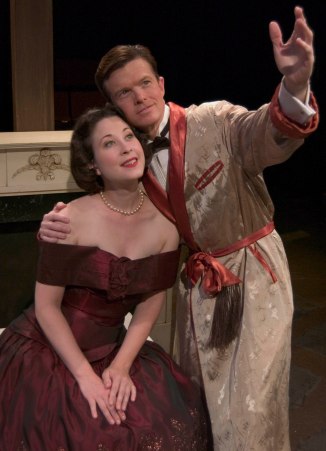


But Not Goodbye at Main Street Theater
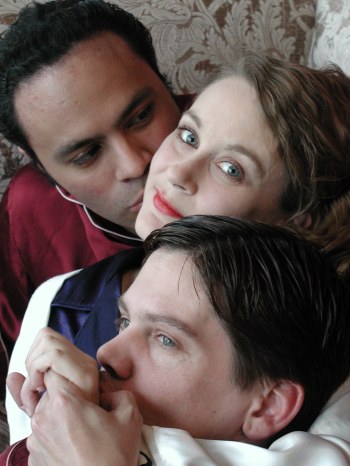
 Claire Hart-Palumbo